River City Stories
A web-driven interactive display for The Cube that helped visitors explore archival images of Brisbane from the 1800s to today.
Overview
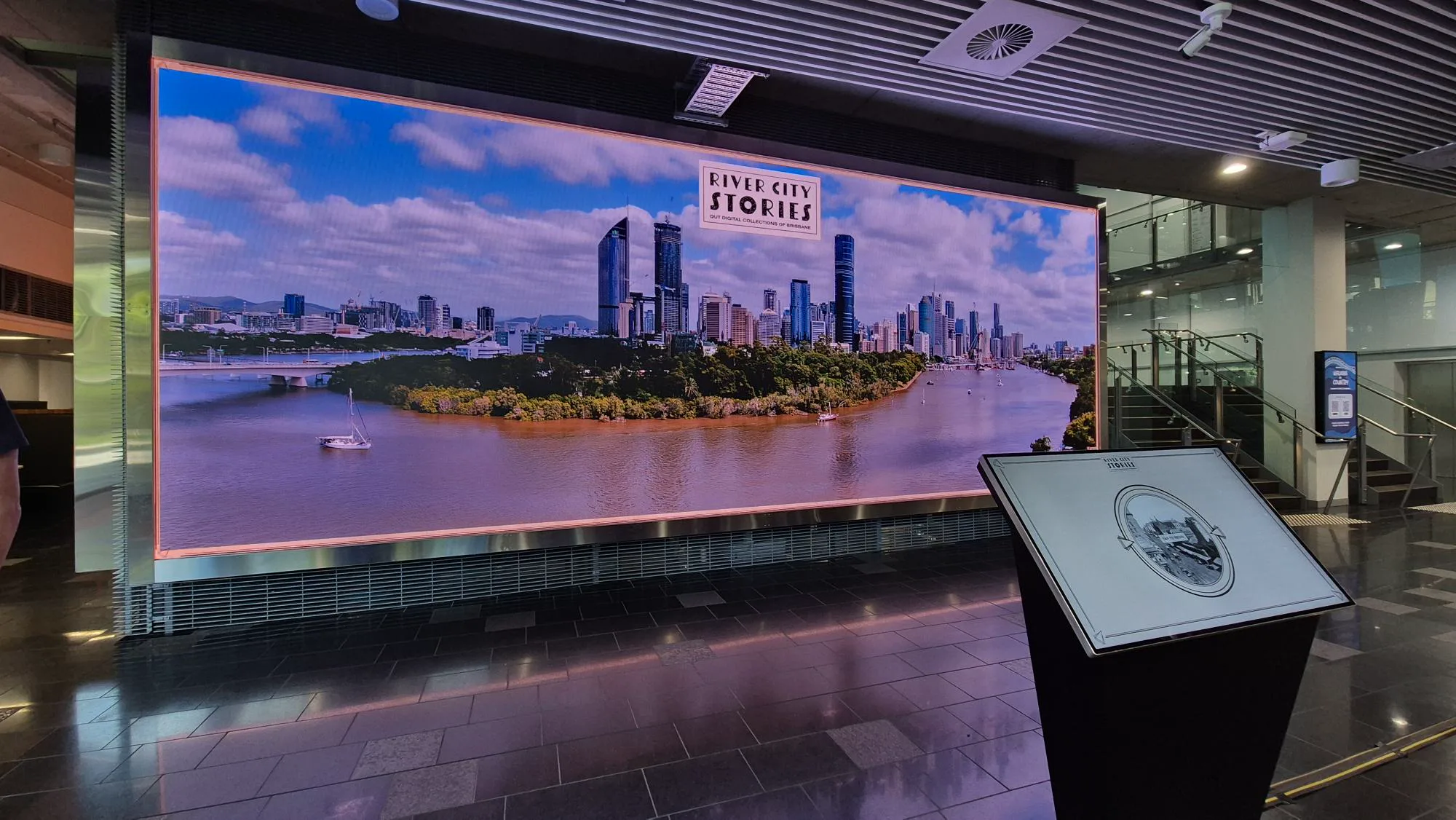
River City Stories was a QUT project created for The Cube using archival images from QUT Digital Collections. The public experience explored Brisbane's evolution from the 1800s to today through historic and contemporary imagery displayed at large scale.
My role was to help translate the archival material into an interactive digital display. I worked on the design and implementation of a web-driven experience that connected a kiosk screen with The Cube's large LED display, allowing visitors to explore the collection in a more active way.
Challenge
Archival photographs can be rich and evocative, but displaying them on large screens is not as simple as making them bigger. The experience needed to give visitors a way into the collection: what to look at, how to move through it, and how to understand the relationship between Brisbane's past and present.
The challenge was to design an interaction model that worked across two scales: a kiosk interface for selection and control, and a large public screen for shared viewing.
The experience
Visitors used the kiosk screen to explore archival Brisbane imagery. Their interaction connected to the large LED screen, turning the archive into a public, shared display rather than a private browsing experience.
The result allowed archival material to be experienced at the scale of The Cube, where details, streetscapes and changes across time could be seen more dramatically.
What I designed and implemented
- Interactive experience structure
- Kiosk interface design
- Large-screen display logic
- Web-driven implementation
- Connection between kiosk control and LED screen output
- Archival image presentation
- Interaction model for exploring the collection
- Public-facing interface design
- Support for curator / archivist content goals
What this shows
River City Stories shows how digital experience design can help archival material become more accessible and engaging in a public setting. The project was not only about displaying images; it was about creating a way for visitors to move through the collection and see Brisbane's history at a scale that made the material feel present.
River City Stories showed digital layering in a different form again: a web-driven kiosk connected to a large public display. The useful layer was not AR, but an interaction model that helped visitors explore archival material and see Brisbane's history at public scale.
It also shows the practical side of my work: designing and implementing a web-driven system that connected user interaction with a large public display.
Relevance now
This project connects directly to my current practice because it used interaction, structure and context to help people understand a place through visual material. The archive became more than a collection of images; it became a guided public experience.
The same principle sits behind my current work with guided digital layers: helping people understand places, stories and information through the right interface at the right moment.
Project Images